Rewriting Myth in the Age of AI: Yen Chung Cho Explores the Future of Cultural Creation
- WODACC

- Apr 24
- 4 min read
At the Future Art & Design Award UK 2026 Spring Season, Yen Chung Cho was awarded the Gold Prize in AI-Generated Art for AI Cross-Cultural Myth Reconstruction—a project that questions the evolving role of authorship, belief, and cultural narrative in the age of artificial intelligence.
Blending elements of Eastern and Western mythology, the work constructs speculative “future relics,” where traditional belief systems are reimagined through generative technologies. Rather than treating AI as a tool, the project positions it as a collaborator—one capable of reshaping not only visual language, but the very structure of myth-making itself.
Intro

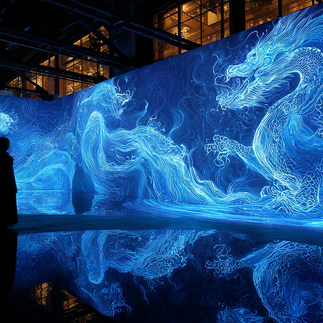
AI Cross-Cultural Myth Reconstruction - Explores artificial intelligence as a potential creator of sacred forms in the digital age. Through generative algorithms, cross-cultural mythological archetypes are encoded, fragmented, and recombined into abstract ritual objects that transcend specific traditions.
Rather than reproducing religious icons, the project produces speculative sacred artifacts shaped by data, symmetry, and luminous structures. These forms embody a post-cultural spirituality where computation participates in imagination.
The work questions authorship and belief in an algorithmic era: when AI learns from humanity’s myths, does it merely reflect collective memory, or does it begin to generate new forms of transcendence?
Interview
Q: What initially inspired this project? Was there a particular idea, moment, or question that sparked its creation?
Yen:
The initial inspiration for this project stems from the profound tension between technology and traditional faith in contemporary society. As a creator who has long focused on the intersection of cultural heritage and digital technology, I have consistently contemplated a core question: In an era of rapid artificial intelligence development, does humanity still hold a monopoly on the role of “creator”? Or has AI already begun to emerge as a new architect of sacred narratives?
Throughout history, humanity has continuously created myths, with priests, poets, and artisans serving as the “creators” in the past. In the age of algorithms, can AI take over this role and become the new myth-weaver? This question prompted me to employ generative AI as a medium, fusing cross-cultural elements—such as Taiwanese folk legends and Western classical mythology—to create a series of future-oriented sacred objects. Through these works, I aim to explore whether AI can serve as a “new creator” in cultural innovation, while infusing traditional beliefs with the vitality of the digital era.




Q: What was the most exciting or most challenging aspect of bringing this work to life?
Yen:
The most exciting aspect during the realization of this project lies in the unexpected creativity generated by the AI process. The real-time dialogue between human and machine transforms creation from a one-way output into a collaborative construction filled with delightful surprises. This fully embodies the openness and boundless possibilities of art.
The most challenging aspect, however, concerns ethical and interpretive issues. When generating figures such as a “Cyber Mazu” or a “Digital Buddha,” how can we avoid offending the religious sentiments of existing believers? Additionally, AI-generated images often carry uncontrollable cultural hybridity. The key difficulty lies in preventing the results from becoming mere superficial collages, while preserving the dignity and spiritual depth that sacred objects inherently demand.
Q: How was your experience taking part in the Future Art & Design Award UK?
Yen:
This award has strengthened my conviction that AI art is not merely about technology, but about how we reimagine the future destiny of cultural heritage. It may be deconstructed by algorithms, yet it can also be revitalized and given new life through them. We are only just standing at this crossroads.
FADA not only affirms the fusion of technology and art, but also places great emphasis on the social and cultural significance behind the works. This aligns closely with my original intention to explore the role of AI within human systems of belief. The entire participation process—from application to the presentation of results—has demonstrated the organizer’s high level of professionalism, leaving me with great anticipation for the future development of art. I sincerely thank the judging panel and the organizing team for providing this platform. I also look forward to continuing to promote more cross-cultural and technological art dialogues through similar international platforms in the future.

Q: Would you please like to share your website, biography, photos, and any social media links for showcasing and promotion?
Yen:
I am an designer with over 10 years of professional experience, specializing in product styling and design methodologies. My work spans across transportation design, consumer products, and machinery, with a strong ability to integrate design concepts into market-oriented solutions.
I have received multiple international design awards, including the Good Design Award (Japan). In recent years, I have focused on AI-assisted design, exploring how generative technologies can transform design workflows and business models. My goal is to bridge design practice, research, and education to foster innovation in the design industry.
Editor’s Note
In AI Cross-Cultural Myth Reconstruction, Yen Chung Cho raises a question that extends far beyond art: who—or what—becomes the storyteller of our future?
By positioning AI as both tool and co-creator, the work challenges traditional notions of authorship while opening new possibilities for cultural continuity. It is within this tension—between belief and algorithm—that a new form of mythology begins to emerge.
Follow the Artist

IG