Above the Mud Line: Tracing Memory in the Aftermath of Disaster
- WODACC

- May 4
- 3 min read
At the Best Photography Awards UK 2026 Spring Season, Chen Hao Yang received the Gold Award in Photojournalism for Above the Mud Line, a work that shifts attention from the spectacle of disaster to the quiet persistence of recovery.
Captured in Hualien, the photograph reflects the aftermath of a natural event triggered by Typhoon Ragasa. Rather than documenting the moment of destruction, the image focuses on what follows—the stillness, the traces, and the gradual return of life. Through subtle composition and layered narrative, the work reveals how landscapes remember, and how people endure.
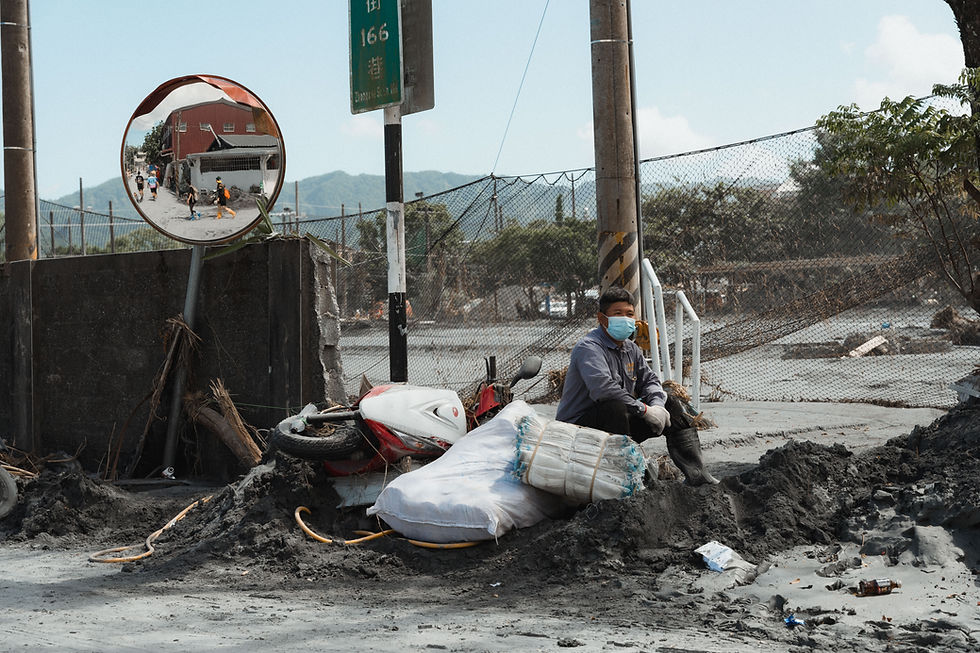
This photograph documents the site following the overflow and breach of a landslide-formed barrier lake in the Mataian Creek area of Hualien, Taiwan, in September 2025. The event was triggered by heavy rainfall brought by Typhoon Ragasa, which caused the water level of the natural dam to rise rapidly and overflow, resulting in flooding and the deposition of mud, sediment, and debris in downstream areas. In the frame, an elderly man sits on accumulated mud left behind by the floodwaters, with the visible mud line exceeding two meters in height. On the left, a roadside convex mirror reflects ongoing rescue and cleanup operations, where volunteers and on-site workers continue recovery efforts. These spontaneously organized relief actions are locally referred to in media discourse as “Shovel Volunteers.”
Interview
Q: Could you share the background and setting of this award-winning photo?
Chen:
This photograph was taken in September 2025 in Hualien, Taiwan, following the overflow and subsequent breach of a landslide-formed barrier lake along Mataian Creek. Triggered by intense rainfall brought by Typhoon Ragasa, the event caused large volumes of mud, sediment, and debris to surge downstream, dramatically reshaping the local landscape.
When I arrived at the site, the disaster had already passed its most urgent phase. What remained was a quiet yet powerful aftermath — layers of mud covering homes and roads, and communities beginning the long process of recovery. Rather than focusing on destruction itself, I was drawn to the transitional moment between catastrophe and restoration, where daily life slowly re-emerges amid uncertainty.
Q: Is there a particular detail in this photo that you especially love?
Chen:
One detail I value deeply is the roadside convex mirror on the left side of the frame. While the elderly man sits still in the foreground, the mirror reflects ongoing cleanup and rescue activities happening simultaneously outside the main field of view.
This dual perspective allows two temporalities to coexist within a single image: stillness and action, reflection and participation. The mirror becomes a visual device that expands the narrative space, suggesting that recovery is not confined to what we immediately see but continues beyond the frame.
Q: Did you have any specific inspiration or artistic concept in mind during the creation?
Chen:
My approach was influenced by the idea of observing the “aftermath” rather than the spectacle of disaster. I was interested in how landscapes retain memory through physical traces — in this case, the mud line marking the height of the floodwaters.
The concept emerged naturally on site: the mud line functions almost like a historical measurement, silently recording the scale of the event. By placing a human figure in relation to this mark, the photograph explores the fragile relationship between human presence and natural forces, while also emphasizing resilience through quiet endurance rather than dramatic expression.
Q: What do you hope viewers will feel or reflect upon when they see this photo?
Chen:
I hope viewers pause and consider the time that exists after headlines fade. Disasters are often remembered through moments of impact, yet recovery is slower, quieter, and sustained by collective effort.
The volunteers locally referred to as “Shovel Volunteers” represent a form of spontaneous civic solidarity. Through this image, I hope audiences reflect not only on vulnerability in the face of nature, but also on the understated strength found in communities rebuilding together. Ultimately, the photograph invites contemplation about memory, resilience, and the human capacity to remain present even after disruption.
Editor’s Note
In Above the Mud Line, Chen Hao Yang turns away from immediacy to focus on duration.
The photograph reminds us that the true story of disaster does not end when the event passes—it continues in the quiet, persistent act of rebuilding. Through restraint and observation, the work offers a space not for spectacle, but for reflection.
Follow the Photographer