Award-Winning LIMINALAND Sets a New Benchmark for Residential Design

At the World Front Design Award 2026 Spring Season, architects Luigi Ippoliti and Carmine Pugliese were honored with the Grand Prize – Best Design of the Season in the Residential & Housing category for their visionary project LIMINALAND.
Rooted in the concept of liminality—the state of being between one condition and another—the project reimagines residential architecture as an experiential journey rather than a static container. Through thoughtful transitions, layered spatial relationships, and a carefully balanced architectural language, LIMINALAND explores how design can shape not only physical environments but also emotional and perceptual experiences of dwelling.

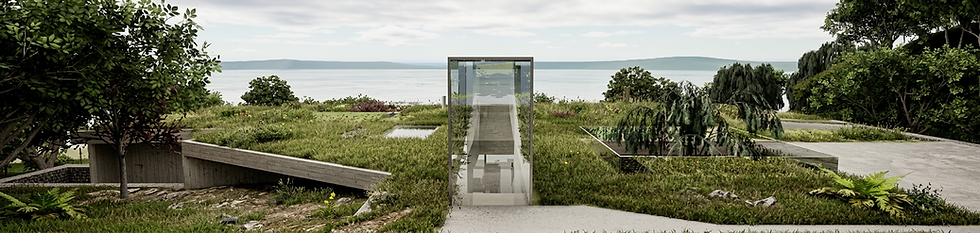
Building within a natural setting is, first and foremost, an act of attentive listening rather than assertion, a delicate and respectful exchange between the structure and its surroundings. Liminaland has been carefully designed to withdraw from immediate view, ensuring the uninterrupted flow of the landscape.
The residence draws inspiration from the rhythms and contours of its environment, reinterpreting them with a modern sensibility. The interiors are arranged along a central spine, thoughtfully punctuated by internal courtyards that provide abundant natural light, shaping the rhythm of living spaces and enriching the spatial experience.
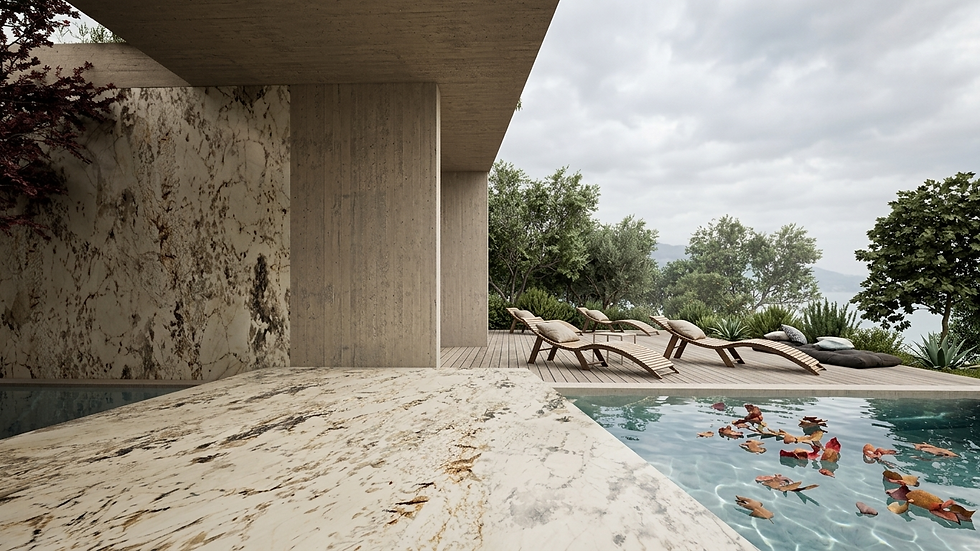
The boundary between inside and outside is deliberately softened: untreated wood, local stone, and concrete integrate fluidly, dissolving divisions and encouraging an authentic connection with the environment. Projecting wooden platforms, reminiscent of piers or terraces, extend outward, reinforcing the visual relationship with nature and deepening the sense of immersion.
This retreat harmonizes with the landscape through a refined selection of materials and tones that reflect the natural palette of the surroundings, achieving a subtle yet sophisticated presence. Architectural features, characterized by clean and essential lines, merge with spontaneous vegetation, enhancing its organic beauty while respecting the ecosystem. The bright, expansive interiors promote a seamless transition between spaces, reinforcing an ongoing dialogue with the outdoors.

The project establishes a profound and dynamic dialogue with local culture, thoughtfully selecting authentic materials capable of evoking layered narratives accumulated over time. The presence of artworks created by local artists, combined with creative yet meaningful reinterpretations of traditional elements, such as the evocative use of fishing nets repurposed as vertical partitions in certain interior spaces, clearly expresses the design's intent to foster a meaningful connection between architecture and place. Far from being mere nostalgic references or superficial allusions to the past, the project becomes a spatial exploration that investigates the potential of contemporary living as a tangible and symbolic experience of belonging. It constantly invites exploration of the territory through the very act of inhabiting the architecture, creating a fertile interplay between the language of contemporary design and deeply rooted cultural values. The resulting spaces are thus alive with expressive tensions and poetic resonances, bridging memory and modernity.
In this way, Liminaland transcends traditional architecture, becoming an immersive experience, a discreet yet profound presence that elevates its surroundings while fostering a meaningful connection between shelter and landscape.
Interview
Q. What initially inspired this project?
Luigi Ippoliti & Carmine Pugliese:
LIMINALAND originates from a reflection on the concept of “liminal space,” understood as a place of transition, suspension, and transformation.
The inspiration comes from observing environments that exist between reality and perception, between what is familiar and what feels uncanny. We were interested in investigating the value of the threshold not only as a physical element, but also as a spatial and emotional condition capable of influencing the way people inhabit, move through, and interpret a place.
In this sense, the project developed from a specific question: how can residential architecture go beyond a merely functional response and also become an experience, an atmosphere, and a form of relationship?
From this perspective came the idea of shaping a space in which the transition between inside and outside, between private and collective dimensions, between intimacy and openness, is not abrupt but gradual and fluid, able to accompany contemporary living with greater sensitivity.
LIMINALAND therefore explores how design can accompany the thresholds of living, creating spaces that encourage a fluid and welcoming perception while enhancing the quality of everyday life. Rather than defining a simple domestic container, the project seeks to express the idea of home as a dynamic experience built on balance, continuity, and well-being.
Q. What was the most exciting or most challenging aspect of bringing this work to life?
Ippoliti & Pugliese:
The most exciting aspect was translating an abstract concept into a concrete spatial configuration capable of expressing the theme of liminality through compositional, material, and perceptual choices.
We were particularly interested in working with elements that could suggest continuity, transition, and layering without losing the clarity of the architectural language or the quality of the living experience.
One of the main challenges was maintaining a balance between conceptual strength and actual livability. When a project begins from a theoretical or evocative idea, there is always the risk that it remains confined to a purely narrative or visual dimension.
For us, however, it was essential that the concept be transformed into a genuinely livable space capable of offering comfort, identity, and quality of use.
Another complex aspect was finding the right balance between identity and restraint. We wanted the project to have a clear and recognizable presence without becoming self-referential. For this reason, we worked extensively on the relationship between volumes, thresholds, light, and perception, aiming to create an environment in which the emotional dimension could naturally integrate into everyday life.

Q. During your design process, is there anyone you would like to acknowledge?
Ippoliti & Pugliese:
We would like to thank everyone who contributed, in different ways, to the development of the project.
Every creative process is also a process of dialogue, listening, and sharing, and we believe that the value of a project is built through the relationships that accompany it.
A special thanks goes to the collaborators, professionals, and figures who supported us through critical observations, dialogue, and encouragement. The contribution of those who can offer an external perspective, ask the right questions, or strengthen a design direction is always essential.
At the same time, we recognize the importance of all the educational and professional experiences that have shaped the way we look at space, design, and the role of architecture in everyday life.
We would also like to acknowledge the cultural and professional environments in which we have grown, because every project is, in some way, the result of a broader journey made of study, research, practice, and continuous exchange.
Q. Could you share a bit about your experience taking part in the World Front Design Award?
Ippoliti & Pugliese:
Participating in the World Front Design Award was an extremely meaningful and motivating experience.
Receiving international recognition is always important, not only because of the visibility it offers, but above all because it allows one’s work to be placed within a broader landscape that is open to dialogue with different approaches, cultures, and sensibilities.
For us, this award represented confirmation of the value of the project and of the research direction behind it. It was especially meaningful to see that a work grounded in spatial, atmospheric, and residential reflection could be appreciated within an international context.
Moreover, the award gave us the opportunity to connect with a network of creatives, designers, and professionals from diverse backgrounds, reinforcing the idea that design can serve as a shared language capable of linking local visions with global perspectives.
In this sense, the World Front Design Award was not only an achievement, but also an encouragement to continue our path with greater awareness and openness.
Editor’s Note
In LIMINALAND, Luigi Ippoliti and Carmine Pugliese challenge conventional notions of residential architecture by focusing on what exists between defined conditions rather than the conditions themselves.
The project's greatest achievement lies in its ability to transform an abstract philosophical concept into a tangible architectural experience. Through carefully orchestrated transitions, subtle spatial hierarchies, and an atmosphere shaped by light, perception, and continuity, LIMINALAND proposes a new way of understanding home—not as a fixed object, but as a living sequence of experiences.
Awarded the Grand Prize – Best Design of the Season, the project stands as a thoughtful exploration of contemporary living, demonstrating how architecture can move beyond function to become an instrument for emotional connection, well-being, and spatial discovery.
About the Winners
Luigi Ippoliti
Architect and Designer

Graduated in Architecture from the “G. D’Annunzio” University of Pescara (Italy) in 2014, with a thesis in Historic Building Conservation and Restoration. Registered with the Order of Architects of the Province of Teramo (Italy).
He has gained experience in several professional studios, focusing on architectural design, product design, and national and international competitions, achieving important recognitions.
He has also collaborated with the Universities of Pescara, Milan, and Teramo (Italy) in teaching and research activities.
In 2016, he founded IPPOLITI architecture + design, based in Tortoreto (Italy).
In 2025, he received the Iron Award at the A’ Design Award & Competition and the Silver Award at the IDA International Design Awards for the project “Shake Off”.
Carmine Pugliese
Architect and Designer

Graduated in Building Science and Technology from the Faculty of Architecture at “Sapienza” University of Rome (Italy) in 2015, with a thesis focused on BIM processes applied to historic buildings. Registered with the Order of Architects of the Province of Crotone (Italy).
He has developed professional experience in architectural design, product design, and energy retrofit, participating in national and international competitions.
Since 2020, he has been working as an independent professional based in Cirò Marina (Italy).
In 2022, he achieved third place in a PNRR competition for new school construction in Corigliano Rossano (Italy).
In 2024, with the GARK group, he won first prize for the redevelopment and enhancement project of Punta Alice (Italy).
Follow
Luigi Ippoliti
Website: www.luigiippoliti.com
Email: ippoliti.luigi@gmail.com | info@luigiippoliti.com
Phone: +39 347 8484863
LinkedIn: www.linkedin.com/in/luigiippoliti
Facebook: studio.ippoliti
Instagram: studio.ippoliti
Carmine Pugliese
Phone: +39 392 2464230
LinkedIn: www.linkedin.com/in/carminepugliese
Facebook: carminepugliesearchitetto
Instagram: carminepugliesearchitetto