
Polina Kupchenko: Three Award-Winning Concepts Exploring Human-Centred Design

At the Future Art & Design Award 2026 Autumn Season, multidisciplinary designer Polina Kupchenko received three distinctions across three categories: the Platinum Prize in Environmental Concept Design for Driftwood Dom: An Adaptive Floating Hostel; the Gold Prize in Future-Oriented Design for Beyond Transaction: A Responsive Jewellery Retail Experience; and the Gold Prize in Product Concept Design for Quiet Green. Her work spans environments, experiences and objects, linked by a consistent interest in how people understand and interact with design.
With more than seven years of experience across the UK and Russia, Kupchenko has worked in commercial interiors, wayfinding, information design, products and visual communication. The three recognised concepts reflect this breadth: a floating-hostel proposal, a responsive jewellery retail experience and a research-led product concept concerned with relationships between people and houseplants.

Interview
Please give us a brief introduction about yourself and your creative background.

Polina Kupchenko: I’m a multidisciplinary designer with over seven years of experience across the UK and Russia. My practice is rooted in human-centred design and in understanding how people perceive, understand and interact with environments, information and products. This curiosity about people and their needs has taken me through different areas of design throughout my career. I’ve worked across commercial interiors, wayfinding and information design, product design and visual communication, on projects ranging from large public transport systems to hospitality environments and research-led concepts. Although the outcomes can look very different, for me they are all connected by the same question: how can design make an experience clearer, more intuitive, engaging or simply better for the person using it?
What inspired you to pursue a career in design?
Polina Kupchenko: I think I’ve always been a creative person. I started art school when I was around ten and I’ve been drawing and making things ever since. I honestly find it quite difficult to imagine myself doing something completely unrelated to design. What kept me in it, though, is the idea that creativity can have a very practical impact on people’s lives. For me, design in all its different forms is ultimately about making something better — easier to understand, more enjoyable to use, more meaningful or simply more beautiful. Creating something new that can improve someone’s everyday experience or wellbeing feels very close to my own values, so design has always felt like a natural direction for me.
Can you describe the creative process behind your work and what motivates you to create?
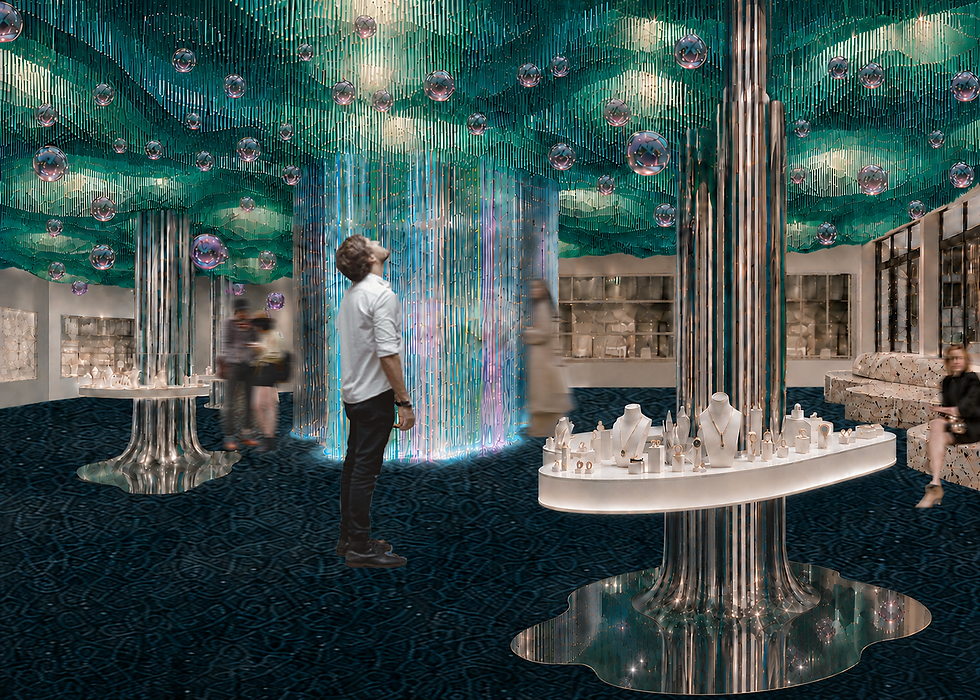
Polina Kupchenko: My creative process is definitely not simple or linear. I’m quite an organised person by nature — I love lists, clear stages and knowing what needs to happen next — but creativity doesn’t always cooperate with that. There are days when I can spend three hours trying to solve something and get nowhere, and then on another day one unexpected idea can completely change the direction of a project. The jewellery store was a good example of this. I had so many ideas in my head — some of them probably a little crazy — but translating that imagined environment into something visual was surprisingly difficult. For a while, none of the tools I was using seemed able to communicate what I could see in my head. It took a lot of experimentation, iteration and persistence to eventually find the balance I was looking for. I think that process is also what motivates me. There is something very satisfying about taking an idea that initially exists only in your imagination and gradually making it understandable to somebody else. Although, like most designers, once I finish something I immediately start seeing another ten things I would like to improve.
What was the most exciting or challenging part of creating the work you submitted to the competition?
Polina Kupchenko: Probably the biggest challenge was translating what I could see in my head into something other people could experience and understand. For me, a strong concept needs to work not only as an idea, but also through the way people interact with and experience it. This was particularly true for the jewellery retail project, where the whole concept depends on atmosphere, movement, reflection and the emotional response of the visitor. Quiet Green presented a very different challenge because it grew from research into people’s relationships with their houseplants, so I needed to communicate not only the object itself, but also the behaviours and rituals behind it. One of the projects was also developed further specifically for the competition, which gave me a good reason to revisit earlier decisions and ask whether the final presentation really communicated the original design intent. That process was challenging, but also probably the most enjoyable part.

How would you describe your creative style and the key characteristics that define your work?
Polina Kupchenko: I think my work sits somewhere between structure and experimentation. I need structure — clear questions, research, priorities and a plan — because without that even the most exciting creative idea can lose its purpose. At the same time, I think you have to give yourself permission to test the strange ideas as well. Some will go nowhere, but occasionally the slightly ridiculous idea you almost dismissed becomes the thing that gives a project its identity. That balance probably defines my work best: understanding people and the problem first, building a clear framework around it, and then leaving enough freedom for curiosity and experimentation to take the project somewhere unexpected.
What has been your experience participating in the competition? Were you satisfied with the process and results?
Polina Kupchenko: It was a really interesting experience, especially because of the range of categories and disciplines represented in the competition. I spent quite a lot of time looking through previous winners before submitting, and it was fascinating to see how differently designers approached their work. It was also my first experience entering an international design competition, so receiving recognition for all three projects was a very meaningful result for me. I received two Gold Prizes and a Platinum Prize across three different design categories. What I valued most was seeing such different parts of my design practice recognised within the same competition.

Where do you see the future of the art and design industry heading in the next 5-10 years?
Polina Kupchenko: I think the next five to ten years will change design enormously, particularly because the tools available to us are evolving almost daily. We’ll probably see new forms of creative practice that are difficult to properly imagine from where we are now. What interests me most, though, is that the faster technology develops, the more important the human side of design becomes. Tools can help us generate, test and visualise ideas much faster, but understanding why people behave in a certain way, what they actually need and how design affects their everyday experience is a different question — and, I think, an increasingly important responsibility for designers. I hope the future of design is not simply about producing more, faster. I’d like to see technology give designers more time and freedom to understand people better, experiment more and create things that genuinely improve everyday life.
Editor’s Note
Kupchenko’s three awarded projects are distinct in category and purpose, yet they share an emphasis on the human experience of design. Beyond Transaction considers the emotional and spatial character of retail; Quiet Green begins with research into people’s habits and relationships with houseplants; and Driftwood Dom extends her thinking into an environmental concept.
The combination of one Platinum Prize and two Gold Prizes reflects a multidisciplinary practice that balances structured research with experimentation. Rather than presenting design as the production of compelling images alone, Kupchenko places value on making ideas understandable, usable and meaningful to the people encountering them.
Follow the Designer
Linkedin:
Quiet Green — Threads:
Quiet Green — Instagram:


