
Si · Flow: Crafting Spaces of Tranquility, Balance, and Belonging

At the Future Art & Design Award UK 2026 Spring Season, Si · Flow by Wu-Su Interior Design received the Gold Prize in the Interior Design category for its refined interpretation of contemporary living through the language of light, air, and spatial restraint.
Designed as a residence for a retired couple, the project transforms the ideas of cloud layering and airflow into a calm architectural narrative. Through carefully controlled material transitions, softened reflections, and concealed functionality, the space creates an atmosphere of quiet elegance—one that reflects a slower rhythm of life shaped by memory, stillness, and emotional comfort.

The project is a newly completed apartment designed for a retired couple. After entering retirement, life no longer revolves around constant upward pursuit, but instead embraces the freedom to pause and linger at different heights, much like layers of clouds forming a stratified language of living. Drawing inspiration from “cloud layering” and “airflow,” the designer shaped a low-tension living rhythm, allowing private spaces to carry the narratives of daily life. Permeation and reflection articulate the layered depth of clouds, while stable and understated surfaces support the traces of everyday living. Through the interplay of light and air, the space cultivates a lifestyle that feels unhurried, light, and gently paced.
“Si” — the privately held layers of living.
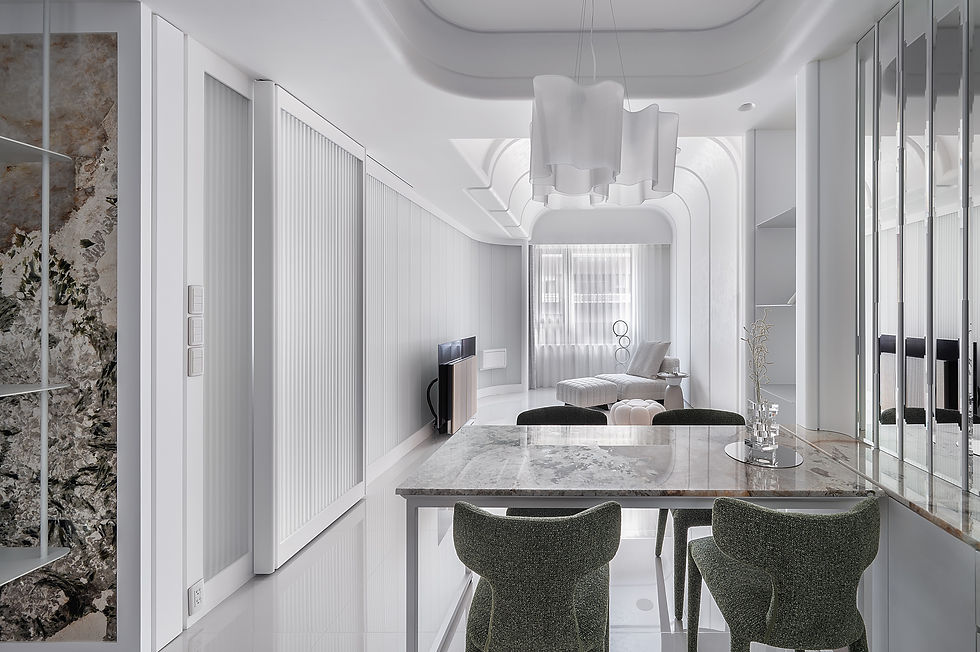
At night, the crystalline veining of translucent marble emerges, emitting a soft, jade-like glow. Paired with floating metal display structures and slender metal shelves, the design creates a sense of suspension that replaces conventional heavy cabinetry. Volumes are visually thinned and blank space unfolds, allowing collections to receive full visual respect within the space. The dining table continues the same stone language, transforming private taste from something merely viewed into a tactile, everyday experience.
“Flow” — the breathing of space.
Geometric conflicts created by cabinetry are resolved through curved walls and reflective metal surfaces, transforming rigid storage functions into gentle spatial guidance. U-shaped glass extends visual depth, while sliding doors incorporate side windows, resembling residual beams of light penetrating layers of clouds. The ceiling employs continuous arcades and segmented light bands to draw longitudinal perspective, guiding the gaze forward in a smooth motion. Rather than dividing space with partitions, the design achieves continuity and flow through curves and rhythmic lighting.

The original light-colored polished quartz tile flooring was retained as the spatial “horizon,” spreading beneath the feet like a sea of clouds. In addition to responding to environmental considerations, it establishes a stable yet understated foundation. Grout refinement techniques soften tile divisions, forming a continuous cloud-like surface that supports the overall visual rhythm.
Stone materials discreetly bear the weight of daily life, providing stability within a light visual context. Metal, glass, and mirrored materials are layered as interfaces for light, using reflection and translucency to depict variations in cloud elevation. Special coatings soften boundaries like mist, allowing walls and ceilings to recede into the air. Through the interplay of lightness and solidity, presence and absence, the space forms a livable environment that is both stationary and fluid, like clouds that invite pause and movement.
The site spans approximately 86.9 square meters, comprising a living room, dining room, kitchen, master bedroom, secondary bedroom, and walk-in closet. The original layout was largely preserved, with partial adjustments to the kitchen and wardrobe areas to enhance storage and equipment functionality.
Spatial expansion was achieved not through major demolition but through vertical and horizontal continuity. Vertically, translucent stone end walls and curved surfaces draw the gaze inward, while the ceiling’s arched vocabulary extends toward the living core. Horizontally, U-shaped glass integrates side windows through sliding doors, allowing light and airflow to move freely while enhancing visual depth.
Interview
Q. Could you introduce yourself and share the journey that has shaped your creative identity?
Chun-Yu Chang:
I am Chun-Yu Chang from Taiwan and currently serve as the Design Director of Wu-Su Interior Design.
For me, the starting point of design lies in improving the convenience of daily life while giving each space a unique sense of taste and texture, allowing every environment to tell its own story. Through years of practical experience and countless projects, I gradually developed a creative approach that emphasizes the proportion of natural light and shadow, as well as the use of sustainable materials.
I hope to transform my commitment to modern aesthetics into a warmth that residents can genuinely feel in their everyday lives—creating spaces that evoke a sense of belonging and making design an extension of a beautiful life.

Q. What is the story behind your awarded project? Could you elaborate on its concept, context, and defining elements?
Chang:
This project was designed as a residence for a retired couple. While conceptualizing the spatial atmosphere, I deeply felt that retirement is no longer about striving upward endlessly, but about learning to pause gracefully at different stages of life.
Therefore, the design takes “layered clouds” and “flowing air” as its core imagery, constructing a spatial language based on gradual transitions and movement. Through customized private spaces, the home carries the rhythms of daily life. Material transparency and reflection are used to depict the lightness and layering of clouds, while stable and understated surfaces quietly support the traces of time.
Within the slow rhythm of natural light and airflow, the project creates an elegant lifestyle that feels timeless, low-tension, and unhurried.
Q. What inspired you to pursue a path in art, design, or the creative industries? Was there a defining moment?
Chang:
Since childhood, the question “Why?” has always been the starting point for how I understand environments and also the driving force behind my design evolution.
Whenever facing a fixed spatial condition, I instinctively imagine alternative possibilities and reconsider how scale, circulation, and functionality might be restructured. This desire reflects my inability to simply accept things as they are.
The turning point that led me into interior design came from a subconscious spatial awakening. In a dream, I constructed an ideal home completely different from reality, and I suddenly realized how deeply spatial perception and creative energy already existed within me.
That desire—to transform abstract consciousness into tangible spaces—ultimately led me onto this path.

Q. Could you guide us through your creative process—from initial idea to final execution? What fuels your creativity?
Chang:
My creative process is a spatial evolution that moves from rationality toward emotional expression.
The first step is objectively analyzing the residents’ lifestyle patterns and daily habits, then translating those rational observations into emotional design language. In this project, the inspiration came from the softness of clouds and air. However, transforming such intangible imagery into a physical environment inevitably involves challenges in material translation and construction details.
What continuously supports me throughout this process is belief. I strongly believe that the persistence to transform invisible aesthetics into real experiences is not only the solution to practical obstacles, but also the most essential faith shared by all designers and artists.

Q. During the development of your awarded work, what were the most compelling or challenging aspects you encountered?
Chang:
The most challenging—and at the same time most fascinating—aspect of this project was the “translation of material language.”
The question was how to use rigid architectural materials to precisely express the softness and fluidity of air and clouds. Since spatial construction inevitably relies on physically heavy materials, the greatest challenge during execution was overcoming their inherent rigidity.
We repeatedly studied surface reflectivity, transparency, and lighting calculations in order to visually reduce the weight and thickness of the materials.
When these hard surfaces began reflecting light like drifting clouds and mist, that moment—where abstract atmosphere successfully transcended physical limitations—became the most rewarding part of the creative process.

Q. How would you define your creative language or style? What distinguishes your work from others?
Chang:
I prefer not to define my work through a single stylistic label. Instead, I see space as a highly inclusive medium. I hope residents can freely discover emotional meanings within the design language and form deep connections with the environment.
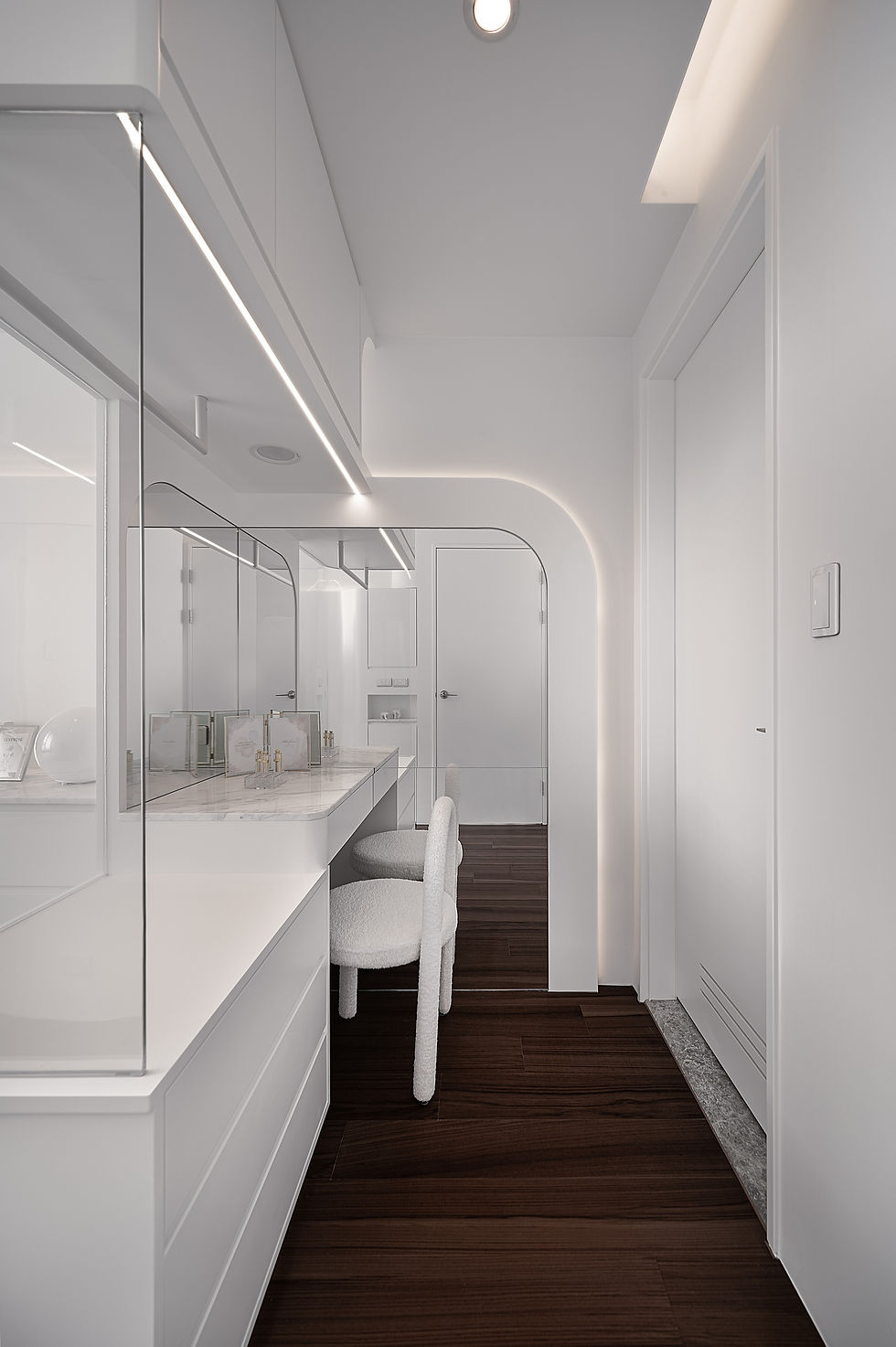
If there is one defining characteristic in my work, it is my pursuit of “hidden functionality.” Daily life inevitably comes with complex storage needs, but I strive to seamlessly integrate these practical functions into architectural lines and material surfaces, intentionally reducing the visual presence of cabinetry and functional interruptions.
When fragmented functional elements disappear, the focus can return to the pure movement of light and shadow, creating spaces that balance both everyday practicality and aesthetic depth.

Q. How was your overall experience participating in this competition? How do you perceive its value within the creative field?
Chang:
Participating in the Future Art & Design Award UK was a deeply reflective experience for me. Presenting my work on an international platform also encouraged me to reconsider the universal values of spatial design from a broader perspective.
It was not only a presentation of results, but also a valuable dialogue with global creative thinking.
I believe FADA’s emphasis on “forward-thinking” and “innovation” precisely reflects the mission of contemporary design. The value of this award lies not only in recognition, but in its ability to encourage creators to break beyond existing frameworks.
It allows abstract design concepts to resonate internationally and strengthens my determination to continue exploring spatial tension and transforming invisible aesthetics into lived warmth.

Q. Looking ahead, what directions or aspirations would you like to explore in your future work?
Chang:
Looking forward, I hope to further deepen the language of sustainable coexistence with nature in my future creations.
I plan to continue exploring the relationship between light ratios, natural ventilation, and spatial microclimates, while seamlessly integrating environmentally sustainable materials into modern aesthetics to dissolve the rigid boundary between the artificial and the natural.
In terms of design goals, I hope to gradually remove unnecessary decoration and pursue a purer form of “trace-free design.” Continuing my exploration of hidden functionality, I want future spaces to carry rich layers of living experience through extremely restrained visual tension, responding more precisely to the inner needs of residents.
Ultimately, I hope these spaces can transcend their physical boundaries and become vessels of emotional healing and stability—while continuing to communicate deeper spatial philosophies to the international design world.
Editor’s Note
In Si · Flow, Wu-Su Interior Design transforms interior architecture into a sensory experience shaped by lightness, restraint, and emotional rhythm.
Rather than relying on overt visual spectacle, the project achieves its power through subtle spatial layering and material sensitivity. The invisible movement of air, reflections, and concealed functionality become the true language of the space, creating an environment where tranquility itself becomes a design material.
The project reflects a contemporary shift in interior design—away from decorative excess and toward spaces that quietly support emotional well-being, timelessness, and everyday human experience.
Wu-Su Interior Design
Website: https://www.wu-su.design/


