
The Unfading Flowers: CHANG YUN-HSUN Transforms 2,000 Petals into an Enduring Work of Art

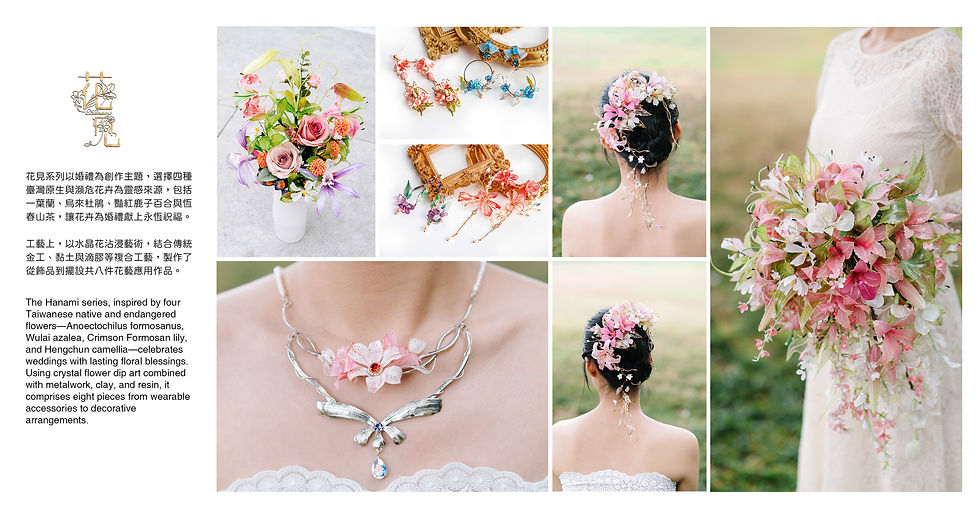
At the Future Art & Design Award 2026 Summer Season, artist CHANG YUN-HSUN (張芸薰) received the Gold Prize in the category of Artistic Expression Through Mixed Metal Media for The Unfading Flowers. Standing approximately 75 centimetres high and composed of around 2,000 individually crafted petals and leaves, the cascading floral work brings together metalwork, resin, clay, and Japanese crystal flower techniques to transform the fleeting beauty of flowers into an enduring artistic form.

Inspired by nature and shaped through meticulous craftsmanship, Chang’s practice spans Japanese crystal flowers, clay art, metalwork, and three-dimensional forms. Her work seeks not only to capture the delicate appearance of plants, but also to explore their emotional and symbolic qualities, creating objects that connect craftsmanship with reflections on nature, ecology, and the value of life.
Interview
Q1. Please give us a brief introduction about yourself and your creative background.
CHANG YUN-HSUN:
My creative practice is inspired by nature and encompasses Japanese crystal flower art, clay craft, metalwork, and three-dimensional forms.
Over the years, I have continued to develop my understanding of different materials and techniques. Through intricate handcrafting, I transform the fleeting moment of flowers in bloom into works of art that can be preserved over time.
I hope my work not only demonstrates the delicacy and beauty of craftsmanship, but also conveys my concern for nature, ecology, and the value of life, allowing each piece to become a bridge between emotion and culture.
Q2. What inspired you to pursue a career in art and design?
CHANG:
I have enjoyed making things by hand since childhood and have always been fascinated by flowers and plants in nature.
As I studied metalwork, clay art, and Japanese crystal flower techniques, I gradually discovered my passion for three-dimensional creation and handcrafted art. Through this process, I found an artistic direction that I wanted to continue exploring and developing.
Q3. Can you describe the creative process behind your work and what motivates you to create?
CHANG:
My creative process usually begins with observing nature. I look closely at the forms, gestures, and characteristics of flowers before combining techniques such as metalwork, resin, clay, and Japanese crystal flower craft to gradually transform these observations into three-dimensional works.
For me, creation is not simply about pursuing external beauty. I hope to communicate the warmth of nature and the vitality of life through my work.
Every flower has its own story. Through my hands, I want to reinterpret those stories and allow beauty that would otherwise be fleeting to continue in another form.
Q4. What was the most exciting or challenging part of creating the work you submitted to the competition?

CHANG:
Creating The Unfading Flowers was a significant test of patience and perseverance. The work is a cascading bouquet approximately 75 centimetres high, constructed from around 2,000 individual petals and leaves.
The extensive handcrafting and assembly process required tremendous concentration. There were moments when I wanted to give up, but at the same time, I was always looking forward to seeing the completed work.
That anticipation became an important motivation that carried me through the demanding process.
Q5. How would you describe your creative style and the key characteristics that define your work?
CHANG:
My creative style centres on natural aesthetics and meticulous craftsmanship.
By combining crystal flower techniques, metalwork, and mixed media, I seek to capture the gestures and character of flowers and transform the temporary beauty of nature into enduring works of art.
Q6. What has been your experience participating in the competition?
CHANG:
Participating in this competition has been a very valuable experience for me. From preparing the work to submitting it, the process gave me an opportunity to reconsider and organise my creative ideas while discovering new possibilities within my practice.
Receiving the Gold Prize was a great encouragement. It made me feel that the effort and persistence behind my work had been recognised.
I am very happy to have had the opportunity to share my creative philosophy through this platform. In the future, I will continue dedicating myself to art and design while exploring new possibilities and directions.
Q7. Where do you see the future of the art and design industry heading in the next 5–10 years?
CHANG:
I believe the future of art and design will extend beyond simply creating beauty.
Through artistic practice, we can strengthen the connection between people and nature, allowing design to become an important way of communicating emotion while also expressing ideas about sustainability and our relationship with the natural world.

Editor’s Note
There is an inherent paradox at the heart of The Unfading Flowers: flowers are among nature’s most recognisable symbols of transience, yet CHANG YUN-HSUN seeks to preserve their moment of bloom. Through metal, resin, clay, and crystal flower techniques, something ephemeral is transformed into a physical form designed to endure.
The scale and craftsmanship of the work reinforce this idea. Approximately 2,000 individually crafted petals and leaves come together to form a 75-centimetre cascading composition, turning repetition, patience, and manual labour into essential parts of the artistic expression. The resulting work is not simply an imitation of nature, but an interpretation of its delicacy and vitality.
Recognised with the Gold Prize at the Future Art & Design Award 2026 Summer Season, The Unfading Flowers reflects Chang’s continuing exploration of nature, craftsmanship, and permanence. In preserving the gesture of a flower beyond its natural lifespan, the work asks us to reconsider how art can hold onto moments that would otherwise disappear.
Follow the Designer
Facebook: https://www.facebook.com/Saltedfishhouse
Threads: https://www.threads.com/@hanami_art_


