
Top Architecture Trends in 2026

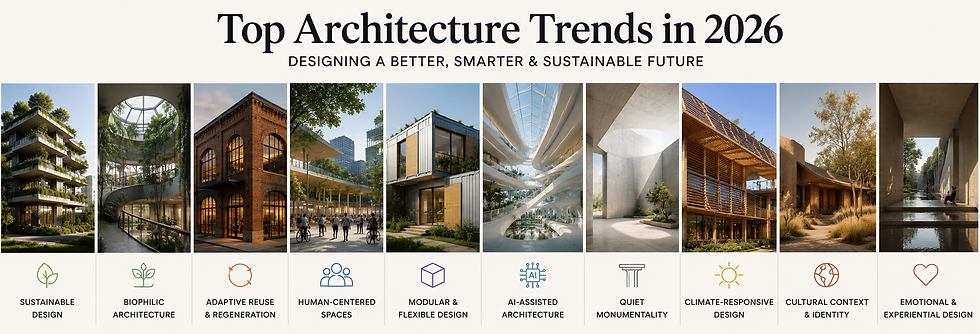
Architecture in 2026 is evolving toward a more human-centered, sustainable, and emotionally intelligent future. As cities, communities, and lifestyles continue to change, architecture is no longer defined only by form, function, or visual impact — it is increasingly shaped by environmental responsibility, cultural identity, well-being, adaptability, and long-term social value.
Across residential, commercial, hospitality, cultural, and urban projects, architects are embracing sustainable materials, biophilic strategies, adaptive reuse, modular systems, and immersive spatial experiences. The most influential architectural works of 2026 are not simply visually striking; they respond thoughtfully to climate, community, context, and human experience.

From sustainable architecture and adaptive urban design to AI-assisted workflows and emotionally resonant public spaces, the architecture trends of 2026 reflect a broader shift toward design that is both visionary and responsible.
This article explores the leading architecture trends shaping global creative industries in 2026, highlighting emerging design directions, material innovations, and award-winning architectural approaches redefining the built environment.
Sustainable Architecture Becomes the Standard
Sustainability is no longer a secondary consideration in architecture — it is becoming a fundamental expectation.
In 2026, architects are increasingly designing buildings that reduce environmental impact through energy-efficient systems, passive design strategies, renewable materials, natural ventilation, solar integration, water conservation, and low-carbon construction methods.
Rather than treating sustainability as a technical add-on, contemporary architecture is integrating environmental responsibility into the core identity of each project.
This trend is especially visible in residential developments, cultural institutions, hospitality projects, educational buildings, and urban masterplans. Buildings are being evaluated not only by their visual presence, but also by how responsibly they interact with the environment.
The most forward-thinking architectural projects combine sustainability with beauty, functionality, and emotional experience, proving that responsible design can also be highly expressive and memorable.
Biophilic Architecture and Nature Integration
Biophilic architecture continues to gain momentum in 2026 as people seek stronger connections between built environments and the natural world.
Architects are incorporating natural light, greenery, water features, open-air courtyards, green roofs, living walls, organic forms, and landscape-responsive planning into contemporary buildings.
This approach goes beyond aesthetics. Biophilic architecture is closely linked to well-being, comfort, productivity, and emotional balance. Buildings that connect people with nature often feel calmer, healthier, and more restorative.
In dense urban environments, biophilic design is becoming especially important. As cities grow more crowded and digitally intensive, architecture that introduces natural elements into daily life can significantly improve the quality of urban experience.
In 2026, nature is no longer treated as decoration around architecture. It is becoming part of the architecture itself.
Adaptive Reuse and Regenerative Design
Adaptive reuse is becoming one of the most important architectural movements of 2026.
Instead of demolishing existing buildings, architects are increasingly transforming old factories, warehouses, schools, offices, churches, and historic structures into new cultural, residential, hospitality, and commercial spaces.
This approach supports sustainability by reducing construction waste and preserving embodied carbon. It also creates deeper cultural continuity by allowing buildings to carry historical memory into new uses.
Adaptive reuse projects often produce highly distinctive architectural experiences because they combine old and new materials, preserved textures, contemporary interventions, and layered spatial narratives.
Regenerative design takes this idea even further by asking how architecture can actively restore ecosystems, communities, and social relationships rather than simply reducing harm.
In 2026, the most meaningful architecture often begins by asking: what should be preserved, reimagined, and renewed?
Human-Centered Urban Spaces
Architecture in 2026 is becoming increasingly focused on people, movement, accessibility, and community experience.
Cities around the world are rethinking public spaces, mixed-use developments, pedestrian environments, cultural districts, and community hubs to create more inclusive and livable urban experiences.
Human-centered architecture prioritizes comfort, safety, walkability, shade, seating, public interaction, flexible programming, and emotional connection. Instead of designing buildings as isolated objects, architects are increasingly considering how projects contribute to the surrounding community.
This trend is particularly important in urban regeneration, transport hubs, cultural buildings, schools, healthcare spaces, and mixed-use developments.
Successful architecture today is not only about iconic form. It is about how people gather, move, rest, interact, and feel within the built environment.
Modular and Flexible Architecture
Flexibility is becoming a defining quality of contemporary architecture.
In 2026, architects are increasingly designing spaces that can adapt to changing lifestyles, work patterns, family structures, business needs, and community uses. Modular construction, prefabricated systems, movable partitions, flexible floor plans, and adaptable building components are becoming more common.
This trend is strongly influenced by remote work, urban density, housing challenges, sustainability concerns, and the need for faster and more efficient construction methods.
Flexible architecture allows buildings to remain useful over time, reducing the need for constant demolition, renovation, or replacement. It also supports more responsive design in residential, office, educational, healthcare, and hospitality environments.
The future of architecture is not fixed. It is adaptable.
AI-Assisted Architecture and Generative Design
Artificial intelligence is beginning to reshape architectural design workflows in significant ways.
In 2026, architects are increasingly using AI-assisted tools for concept exploration, spatial planning, environmental analysis, visualization, material research, and generative form studies.
AI can help architects quickly test multiple design options, analyze site conditions, simulate lighting performance, optimize circulation, and generate early-stage visual concepts. These tools are expanding creative possibilities while supporting more informed decision-making.
However, the most successful architectural projects continue to rely on human judgment, cultural understanding, ethical responsibility, and emotional intelligence.
AI is becoming a collaborative design tool rather than a replacement for architects. Human creativity remains essential for interpreting context, shaping experience, understanding community needs, and creating meaningful architecture.
Quiet Monumentality and Minimalist Forms
Architectural expression in 2026 is moving toward a quieter, more refined form of monumentality.
Instead of relying solely on dramatic shapes or visually aggressive structures, many architects are embracing restrained forms, clean geometries, natural materials, and carefully composed spatial experiences.
This trend reflects a broader cultural shift toward timelessness, calmness, and understated sophistication.
Minimalist architecture in 2026 is not cold or empty. It is warm, material-rich, and emotionally grounded. Stone, wood, concrete, clay, glass, and textured surfaces are used to create spaces that feel both contemporary and enduring.
Quiet monumentality is especially influential in museums, cultural centers, luxury residences, boutique hotels, spiritual spaces, and civic architecture.
The power of architecture increasingly lies not in visual excess, but in atmosphere, proportion, and presence.
Climate-Responsive Design
As climate challenges intensify, architecture is becoming more responsive to local environmental conditions.
In 2026, architects are placing greater emphasis on climate-sensitive design strategies such as shading systems, passive cooling, rainwater harvesting, flood resilience, thermal mass, natural ventilation, and regionally appropriate materials.
Climate-responsive architecture adapts to its environment rather than forcing a universal design language onto every location.
This approach is especially important in regions affected by extreme heat, flooding, urban heat islands, storms, and changing seasonal patterns.
Buildings are increasingly designed to protect, adapt, and endure. Architecture is becoming a long-term environmental strategy, not just a visual or functional object.
Cultural Identity and Contextual Architecture
Architecture in 2026 is showing renewed interest in cultural identity, local materials, regional traditions, and contextual storytelling.
Rather than creating anonymous global buildings, many architects are drawing inspiration from local landscapes, craftsmanship, histories, rituals, and community values.
This trend reflects growing demand for architecture that feels rooted, meaningful, and culturally specific.
Contextual architecture does not simply imitate tradition. It reinterprets cultural references through contemporary materials, technologies, and spatial ideas.
This direction is especially powerful in hospitality design, cultural institutions, public buildings, heritage projects, and community-centered architecture.
In 2026, architecture that respects place often feels more memorable than architecture that tries to look universal.
Architecture as Emotional Experience
Architecture is increasingly understood as an emotional and sensory experience.
Beyond structure and function, buildings shape how people feel, behave, remember, and connect. Light, shadow, acoustics, material texture, spatial rhythm, temperature, scent, scale, and movement all influence architectural experience.
In 2026, architects are designing spaces that evoke calmness, wonder, intimacy, contemplation, belonging, or inspiration.
This emotional approach is especially important in residential design, cultural spaces, spiritual architecture, healthcare environments, hospitality projects, and public buildings.
Award-winning architecture increasingly succeeds because it creates meaningful human experiences, not only impressive visual images.
The future of architecture is not just about what buildings look like. It is about what they make people feel.
Architecture Trends Across Global Creative Industries
Architecture trends in 2026 are strongly influenced by interior design, urban planning, digital technology, environmental science, art, hospitality, and cultural storytelling.
As creative disciplines continue to intersect, architecture is becoming more multidisciplinary and experience-driven. Architects are increasingly collaborating with artists, designers, engineers, environmental experts, technologists, and communities to create more holistic built environments.
This evolution is changing how architecture is evaluated. The strongest projects are not only beautiful or technically advanced; they are sustainable, adaptive, culturally aware, and emotionally resonant.
As cities and societies continue to face complex challenges, architecture remains one of the most powerful creative disciplines for shaping the future of human life.
Conclusion
Architecture in 2026 is moving toward a future defined by sustainability, adaptability, cultural awareness, and emotional depth.
The most important architectural trends are no longer focused only on iconic forms or visual spectacle. Instead, they emphasize climate responsibility, human well-being, community value, material honesty, and long-term resilience.
From sustainable architecture and biophilic design to adaptive reuse, AI-assisted workflows, and emotionally intelligent spaces, contemporary architecture is becoming more thoughtful, responsive, and deeply connected to the world around it.
As global creative industries continue to evolve, architecture will remain essential in shaping not only how buildings look, but how people live, gather, heal, work, and imagine the future.
Frequently Asked Questions
What are the biggest architecture trends in 2026?
Some of the biggest architecture trends in 2026 include sustainable architecture, biophilic design, adaptive reuse, climate-responsive design, flexible architecture, AI-assisted workflows, and human-centered urban spaces.
Why is sustainable architecture important?
Sustainable architecture reduces environmental impact, improves energy efficiency, supports long-term resilience, and helps create healthier buildings for people and communities.
What is biophilic architecture?
Biophilic architecture integrates nature into the built environment through natural light, greenery, organic forms, water features, natural materials, and landscape-connected spaces.
How is AI influencing architecture?
AI is helping architects explore design concepts, generate forms, analyze environmental conditions, improve visualization, and optimize planning while still relying on human creativity and judgment.
What is adaptive reuse in architecture?
Adaptive reuse is the process of transforming existing buildings for new purposes, preserving cultural memory while reducing waste and environmental impact.


